

Paradise: Love
Paradies: Liebe
Ulrich Seidl’s portrait of a white sex tourist in Kenya is a cautionary tale of 21st-century commodification.
Even if a screening is sold out, tickets are often available 30 minutes before the start of the film at the box office at each venue.

- Director-Producer Ulrich Seidl
- Screenwriter Ulrich Seidl, Veronika Franz
- With Margarete Tiesel, Peter Kazungu, Inge Maux
- Austria 2012
- 120 mins
- UK distribution Soda Pictures
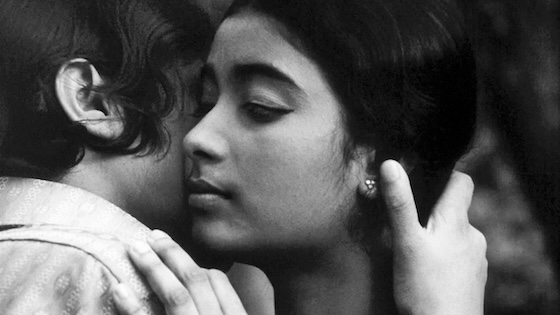
Frustrated, and looking for love in all the wrong places, Teresa (Margarete Tiesel) travels to a beach resort in Kenya where she joins a gaggle of middle-aged white sex tourists known as ‘sugar mamas’. Initially alarmed by the transactional nature of her exchanges with the alluring African men who line the beaches promising sex, her disappointment soon turns to indignation and then, as she begins to assert her plump body, to superiority. Urich Seidl (Dog Days; Import/Export), is one of contemporary cinema’s great provocateurs, and the first of his ‘Paradise’ trilogy about three women from the same family is another confronting and cautionary tale of 21st-century commodification, this time haunted by the spectre of an earlier colonialism. Working again with cinematographers Ed Lachman and Wolfgang Thaler, the simultaneously harsh and seductive visuals take their aesthetic cue from the impact of black skin on Tiesel’s resplendent, fleshy proportions.
Clare Stewart
Director Q&A
Paradise – How did you choose this collective title for the trilogy?
Paradise is the promise of a state of permanent happiness (a word that for many conjures up the desire for sun, sea, freedom, love and sex), as well as a commonly abused concept in the tourism industry. The title thus represents all three of the film’s stories, because in them three women set out to fulfil their unfulfilled dreams and longings.
Why three films involving three women?
...because, despite what people may think, I’m a director who makes films about women. The film grew out of several different starting points. For example, I’ve long been interested in making a film about fifty-something women. And also, my wife Veronika Franz and I once wrote a film about mass tourism that consisted of six different threads. Each dealt with tourists (from the West) and their kind of vacation in the so-called Third World. The theme of sex tourism came up repeatedly in them. We developed that into the story of a family: two sisters and a daughter. Three women looking for a man who don’t correspond to standard ideals of beauty and who – to cite Houellebecq or Jelinek – have low market value. So they look for sexual fulfilment, and also love, elsewhere; in this case, with black men in Africa.
What’s behind your ‘exploding’ the stories?
We don’t write traditional scripts. Individual scenes are described precisely, but the separate threads are recounted like in a short story, and not interwoven. That only happens at the editing table. It’s the result of my working method, the basic principle of which is that you don’t simply execute the approved script, but rather take into account what’s happened in pre-production and also what’s come out during filming. Similarly, as far as possible you shoot chronologically and make sure that the working method remains open to new directions and ideas. Plus, with every film I always try to set myself new challenges, and on Paradise my secret ambition was to film the stories in such a way that, if necessary, they could exist on their own. I spent a year and a half in the editing room on countless rough cuts, trying to interconnect the three stories. And at some points that worked quite well. Still, none of the various versions worked as a single film – a 5 1/2-hour colossus. Instead of being mutually enriching, they actually weakened each other. And finally we came to the conclusion that the best solution artistically was not one, but three separate films. But it wasn’t an easy process.
A sex holiday in Kenya, a radical Catholic mission of conversion in Vienna, a diet camp for adolescents... Why these three ‘stations’?
All three women fall in love, experience love and, along the way, disappointment. For the daughter at the diet camp (where overweight teens spend their vacations), this is the first love of her life, with all its absolutes. For her mother, who travels to Kenya to find love – or sex – it’s a conscious choice after years of being disappointed. And her sister, who loves no one but Jesus, and who has thus found a spiritual, wholly cerebral sexual love, goes even further: What you can’t find on earth, you long for in heaven, the promised paradise.
Ulrich Seidl
Director biography
Born in Vienna in 1952, he studied directing at the Vienna Filmakademie and, after collaborating on the script of Michael Glawogger’s Krieg in Wien (1989), built a substantial, idiosyncratic and often controversial body of documentary work. Werner Herzog memorably named Seidl one of his ten favourite filmmakers and said about Animal Love: ‘Never before in cinema have I been able to look straight into hell’. In 2001 he directed his revelatory first fiction film, Dog Days, which drew on his experience with documentary techniques in darkly profiling the Austrian petit-bourgeoisie, and took prizes in both Venice and Cannes. He has since been represented at the LFF as a contributor to the collective critique State of the Nation and as the immediately recognisable begetter of both the examination of religious faith that was Jesus, You Know and the near-hardcore analysis of labour migration in Import/Export.
Filmography
1980 Einsvierzig (One Forty) [doc s]
1982 Der Ball (The Prom) [doc s]
1984 Look 84 1991 Good News – von Kolpoteuren, Toten Hunden und andere Wienern (Good News: Newspaper Salesmen, Dead Dogs and Other People from Vienna) [doc]
1992 Mit Verlust is zu rechnen (Losses to be Expected) [doc]
1994 Die letzten Männer [doc]
1996 Bilder einer Ausstellung (Pictures at an Exhibition) [TV doc]; Tierische Liebe (Animal Love) [doc]
1997 Die Busenfreund (The Bosom Friend) [TV doc]
1998 Spass ohne Grenzen (Fun without Limits) [doc]
1999 Models
2001 Hundstage (Dog Days); Zur Lage: Österreich in sechs Kapiteln (State of the Nation: Austria in Six Chapters) [doc; co-d]
2003 Jesus, du weisst (Jesus, You Know) [doc]
2006 Brüder, lasst uns lustig sein (Brothers, Let Us Be Merry) [doc]
2007 Import/Export 2010 Im Keller [doc]
2012 Paradies: Liebe (Paradise: Love)

Read the Time Out review.

Become a Member
Get early booking access and enjoy year-round benefits with BFI Membership.
Join today
Festival brochure
Download our digital BFI London Film Festival 2025 brochure, compatible with most screen readers.
Download brochure


