

The Patience Stone
Syngué sabour
Roman Polanski meets the Taliban in this unforgettable account of a beautiful Afghan woman who indulges her most secret desires in the most dangerous of places.
Even if a screening is sold out, tickets are often available 30 minutes before the start of the film at the box office at each venue.

- Director Atiq Rahimi
- Producer Michael Gentile
- Screenwriter Atiq Rahimi, Jean-Claude Carrière
- With Golshifteh Farahani, Hamidreza Javdan, Massi Mrowat
- France-Afghanistan-Germany 2012
- 98 mins
- Sales Le Pacte
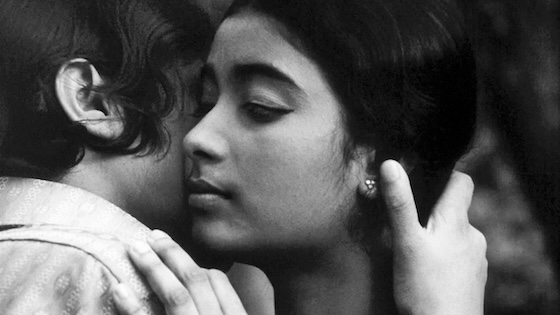
A beautiful Afghan woman tends to her fighter husband in their bomb-shelled bedroom. He is comatose, a bullet wound in his neck. The fighting rages outside while she clings desperately to the hope that one day he will wake up and recover consciousness. That is the deceptively simple premise of director Atiq Rahimi’s adaptation of his own bestselling novel The Patience Stone. Appearances, however, are not what they seem. Gradually, we see the wife – an absolutely spectacular performance by Iranian actress Golshifteh Farahani – turn the tables on the patriarchal society she has been born into and use her husband’s condition to her advantage, confounding the various hostile men around her. Finally able to speak openly for the first time, she reveals her deepest secrets and desires, setting the stage for a breathless climax that will leave audiences both shocked and surprised.
Ali Jaafar
Director statement
When I asked Jean-Claude Carrière to adapt my book Syngué sabour, he said: ‘What are you expecting from me?’ ‘Betray me!’, I answered. It wasn’t said in provocation but with cinematographic vocation. Because what is exciting and challenging for a writer-director, is finding a way to exceed one's own book to show and say in his film all the things he didn’t manage to write using words. The book’s central idea is the myth of Syngué Sabour, the patience stone, a stone on which you can shed your misfortunes, your complaints, your secrets until it’s so full it bursts. In this story, the stone is the husband, a warrior paralysed by a bullet in the neck. The woman, to bring him back to life, has to pray from morning till night for 99 days. But that prayer soon turns into confession. She murmurs in to his ear all the things she has kept locked inside her for so many years. As in my previous books, the characters evolve in extreme circumstances and in a single decor. But our adaptation primarily consists in moving away from this theatrical situation, by deconstructing the Romanesque narrative to arrive at a purely cinematographic dramaturgy. We thus changed the narrative point-of-view. By following the woman’s point-of-view, the camera permits itself to leave the bedroom, to follow the main character out of the house, into the streets of Kabul, into the heart of the war. The camera is mobile, light, wandering, as in Rossellini’s Germany, Year Zero, giving the impression of capturing situations on the spur of the moment. On the other hand, the interior scenes where sensuality, intimacy, dreams and phantasms, memories, regrets and remorse prevail and haunt our heroine’s mind, the camera will harmonise itself to the rhythm of the characters' emotions and very breaths. Supple, gracious, sensual, the camera slides through the bedroom, through the woman’s intimate world, like a confidante, an accomplice. The contrast between the two worlds, outside/inside, social/intimate, war/love, will, in terms of lighting, be interpreted by contrasting images; the crude exteriors, and those, soft and veiled, of the interior where the woman is lit like a source of light and colour, as can be seen in the miniature Persian carpets. The film is also structured by passages leading from the present to the past, making the narration non-linear. However, the woman’s memories are not depicted with systematic and arbitrary flashbacks. It is always the elements and the situations from the present that introduce us in to the past. Like, for example, the combat scene between the fighting quails that the heroine perceives in the streets of Kabul: not only does this scene reflect what the character lived during her childhood, but progressively transforms itself in to her own memory. Just like the wedding party in the whorehouse that reincarnates our main character’s wedding: rendering these flashbacks more poetical than technical. This is how characters in the book, who only exist through the memories and stories told by the woman, come to life. Like the aunt who is an initiating character in the life of our heroine, or her father, a breeder of fighting quails.
Atiq Rahimi
Director biography
As both writer and filmmaker, he is a famous representative of Afghan culture in Europe. A former student at the Franco-Afghan high school of Kabul (born in 1962), he fled his country in 1984 and received asylum from the French state, going on to earn a doctorate of cinema at the Sorbonne. The author of several documentary films, he considers the cinema as the universal language best-suited to discussing the situation of his country of origin. Yet in 1996, when the Taliban took power in Kabul, he felt the need to switch to writing with Earth and Ashes, referring to the mourning and violence that afflicted Afghanistan. He adapted it for cinema himself in 2004, the film being presented in Cannes and receiving a glowing reception. He then published in his native tongue A Thousand Rooms of Dream and Fear in 2002, the photobook Le Retour imaginaire and Syngué Sabour in 2008; now self-adapted for the screen as The Patience Stone.
Filmography
2002 Afghanistan, un État impossible? [doc]
2004 Terre et Cendres / Khâkestar-o-khâk (Earth and Ashes)
2012 Syngué Sabour (The Patience Stone)

Become a Member
Get early booking access and enjoy year-round benefits with BFI Membership.
Join today
Festival brochure
Download our digital BFI London Film Festival 2025 brochure, compatible with most screen readers.
Download brochure


